World's Oldest New Testament Manuscripts
The hot, dry climate of Egypt has proven excellent at preserving very old papyrus manuscripts. They include the oldest copies of New Testament writings.
Over a century ago, papyrologists Bernard Pyne Grenfell and Arthur Surridge Hunt discovered a major papyrus collection at an ancient rubbish dump. It was located near the ancient city of Oxyrhynchus (Greek: Ὀξύῤῥυγχος, modern name Al-Bahnasa), about 160 km (100 miles) up the Nile from Cairo. Hence they are called the Oxyrhynchus Papyri.
This is probably the most important papyrus collection because it includes many very old copies of New Testament passages. The oldest is the small John Rylands papyrus labelled P52, part of a group of manuscripts Grenfell discovered. It is dated to 110-140 AD and contains John 18:31-33, 37-38.
World's Oldest Christian Hymn With Lyrics and Musical Notation
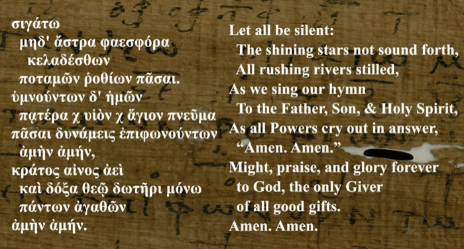
Another remarkable member of the Oxyrhynchus Papyri is Papyrus 1786. Discovered in 1918 and published in 1922, it is now housed in the Sackler Library in Oxford, UK. It contains the Oxyrhynchus hymn (or P. Oxy. XV 1786), dated to c. 250 AD. The hymn has poetic metre and is written in Greek vocal notation. It is the only surviving Greek Christian hymn from the first four centuries AD.
However, it seemed to be largely forgotten for decades, although there were some performances. Originally, it was set to the 'pop (= popular) music' style of its day, so clearly intended for the masses. But it was recently publicized in 2025 and set to modern music. Australian scholar Dr John Dickson, now of Wheaton College Illinois, produced a fresh translation. He teamed up with leading modern Christian musicians, American Chris Tomlin and Australian Ben Fielding.
Hymn to the Trinity, a Biblical Doctrine
The lyrics are most startling. It is a praise to "God, the only giver of all good gifts". But this one God is addressed as three Persons, "the Father, Son, and Holy Spirit" - a clear statement of the doctrine of the Trinity.
As many cultic doorknockers love to tell you, the word Trinity is not found in the Bible. They insist that we should stick only to biblical words. But then 'monotheism' and 'Kingdom Hall' are not found in the Bible either. Neither is the word 'Bible' - so their argument is self-refuting (see this issue, pp. 47-49). But the doctrine most definitely is in the Bible. Like the hymn, the Bible teaches there is one God (Deuteronomy 6:4, Isaiah 44:8). It also teaches that the Father is God (John 6:27, Ephesians 4:6), the Son is God (e.g. Hebrews 1:8), and the Holy Spirit is God (Acts 5:3-4), and is personal (Acts 13:2).
Trinitarian Hymn, a Century Before Nicaea
Another cultic falsehood is that the Trinity doctrine was invented at the First Council of Nicaea (modern name Turkified to İznik), in 325 AD. In reality, this Council concentrated on the Deity of Christ - a vital component of the Trinity, to be sure, but not so much the Trinity per se. As for the word Trinity, Theophilus and Tertullian used it in the second century.
The amazing thing about this old hymn is its clear statement of the Trinity doctrine - a century before Nicaea. It also clearly confronts the pagan culture of its day. In Greek mythology, Zeus was the king of the gods and called the 'giver of good gifts'. But this hymn proclaimed that the real gift-giver is the Triune God of the Bible (Luke 11:13, Romans 8:28). Thus the early Christians were singing Trinitarian theology to the pagans while undermining their gods, even in the face of persecution.