The Bible's Calendar is based upon the movements of the Moon, in particular:   the Moon's Phases, the Lunar Month (about 29.5 days), and the Moon's Metonic Cycle (the period
of time after which the phases of the moon recur on the same day of the year - almost exactly 19 years).   Of relevance to this project are the Moon's Phases, particularly
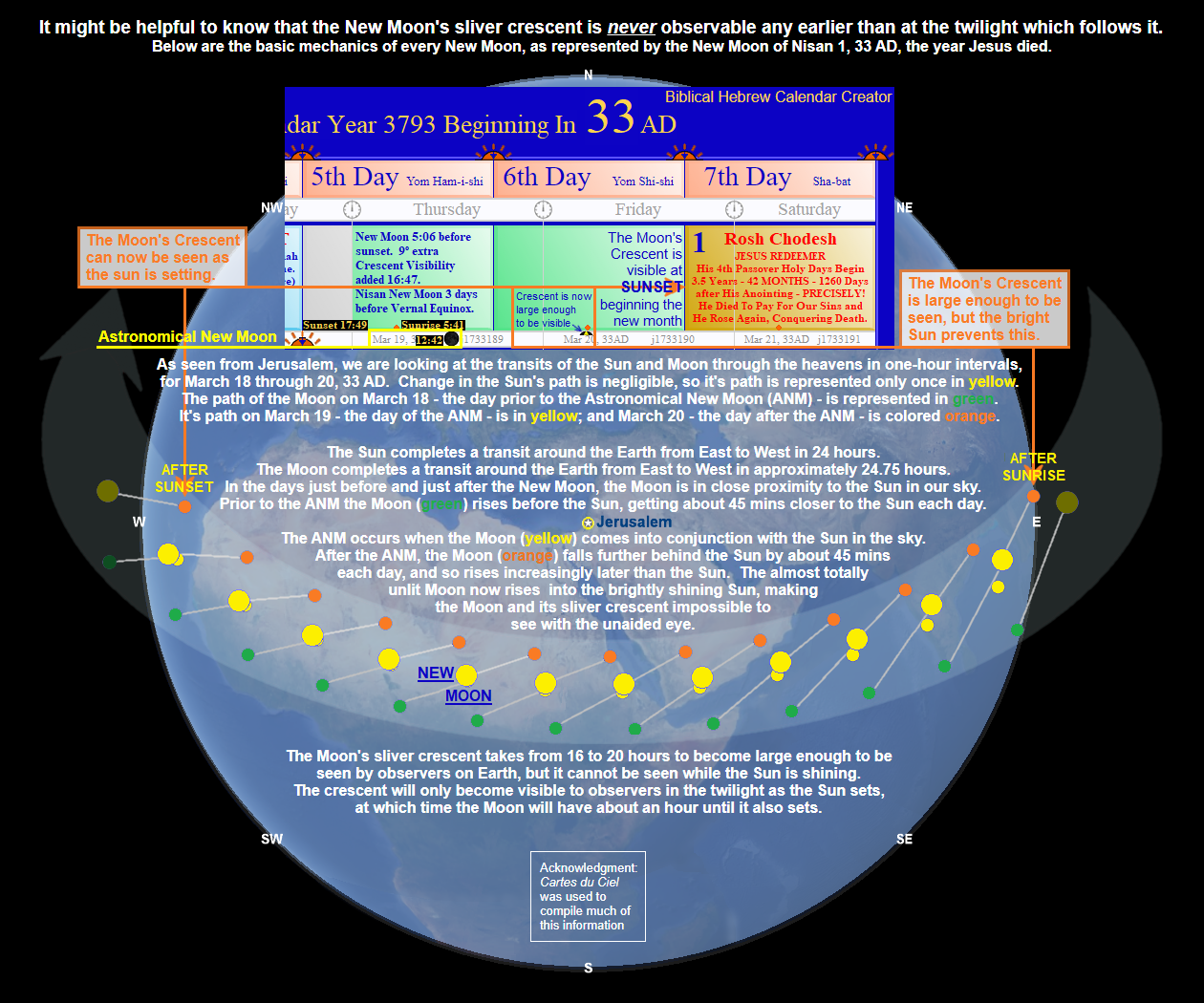
its New Moon Phase; when the Moon is precisely aligned between the Earth and the Sun (180 degrees), and it's surface as viewed from Earth, is completely unlit and unseen.
As instructed by God, the Jewish people set the beginning of each New Month, not by the New Moon itself, but by the first Hebrew Day (beginning at sunset) upon which the
Crescent of the New Moon is visible at Sunset (see: The New Moon In The Hebrew Bible).   So those who would look into the past to find exactly when (upon which
Day of the Week for example) a certain event occurred, do themselves and others a disservice when they do not properly account for the time lag between the Astronomical
New Moon and the assigning of the First Day of the Month at the Crescent.   This tool is meant to assist with establishing Accurate Dating of Bible-Calendar Events.
The Hebrew Calendar:

   The Hebrew calendar, as described in Scripture and in other Hebrew writings, is a lunisolar system -- meaning it employs both the cycles of the moon and the sun.  Months were marked by the sighting of the new moon (1 Samuel 20:5), while the agricultural seasons, tied to the solar year, shaped the timing of major feasts (Deuteronomy 16:1; Exodus 23:15).  Because the lunar and solar cycles do not align perfectly, Israel methodically added an extra month when needed to keep festivals like Passover in their proper season.  This reflects the kind of mathematical and astronomical awareness early Christians required, understanding both solar and lunar cycles to keep their commemorations accurate.

   The calendar God gave to Israel served theological purposes as well:  It reminded the people of His saving acts and structured their year around worship.  Leviticus 23 lays out appointed times; Sabbaths, Feasts and Holy Days; showing how God ordered Israel's life around His covenant and His redemption.


Calandar Parameters:

   Without establishing at least one reasonably strong Biblical-Event Anchor-Point within the biblical timeline; one that is helpful in determining successive Event Time-Points, it is difficult to establish relationships in time, for events which took place long ago, both relative to each other and also within the established historical record.  And if we don't have an accurate understanding of the Biblical Calendar that the Bible's writers were using we may as well not even begin the project.
 
   I wrote my Biblical Hebrew Calendar Creator (BHCC) software after it became clear that online Bible Calendar programs didn't always correctly include all the parameters which were used by the biblical Hebrews.  Or it was impossible to know if all the parameters were operating, without being able to compare results from a program which I knew did include them.
 
   I went to great effort to find the information necessary to create the Correct Calendar incorporating the Correct Parameters.  You should know that there is some disagreement on precisely what those parameters should be, but more than once my decisions in this area were made quite easy after finding what the Bible has to say.
 
   I believe my software, as closely as possible, reveals the Calendar that the Bible-Time Hebrews would have been guided by.  When this information is viewed in conjunction with other information as revealed either within the Bible or within the historical record, the timing of certain crucial events can be established with a degree of certainty.  Carrying on, the more information that subsequently aligns with and supports the dating of events in the timeline, the stronger one's confidence becomes in the dating methodology itself.  We are speaking primarily of the Timing of certain special events in biblical history, and how, with a correctly functioning calendar-creator in hand, those events can be seen to align with the special dates which God speaks of in the Bible.  This is especially relevant to the prime years located near the End or the Beginning of a Millennium, and how the events of these years align with the Feasts and Festivals of the Old Covenant, which God delineates in Leviticus 23 - God's "appointed times"; God's moedim.
  Some of the Calendar parameters pertaining to the biblical timeline that are included in the BHCC, and which may not be included in other calendars, include:


The Mechanics of the New Moon:


Biblical Hebrew Calendar Creator